Cloud Migration Services vs Managed Cloud Services: Practical Scenarios, Costs, and Decision Guide
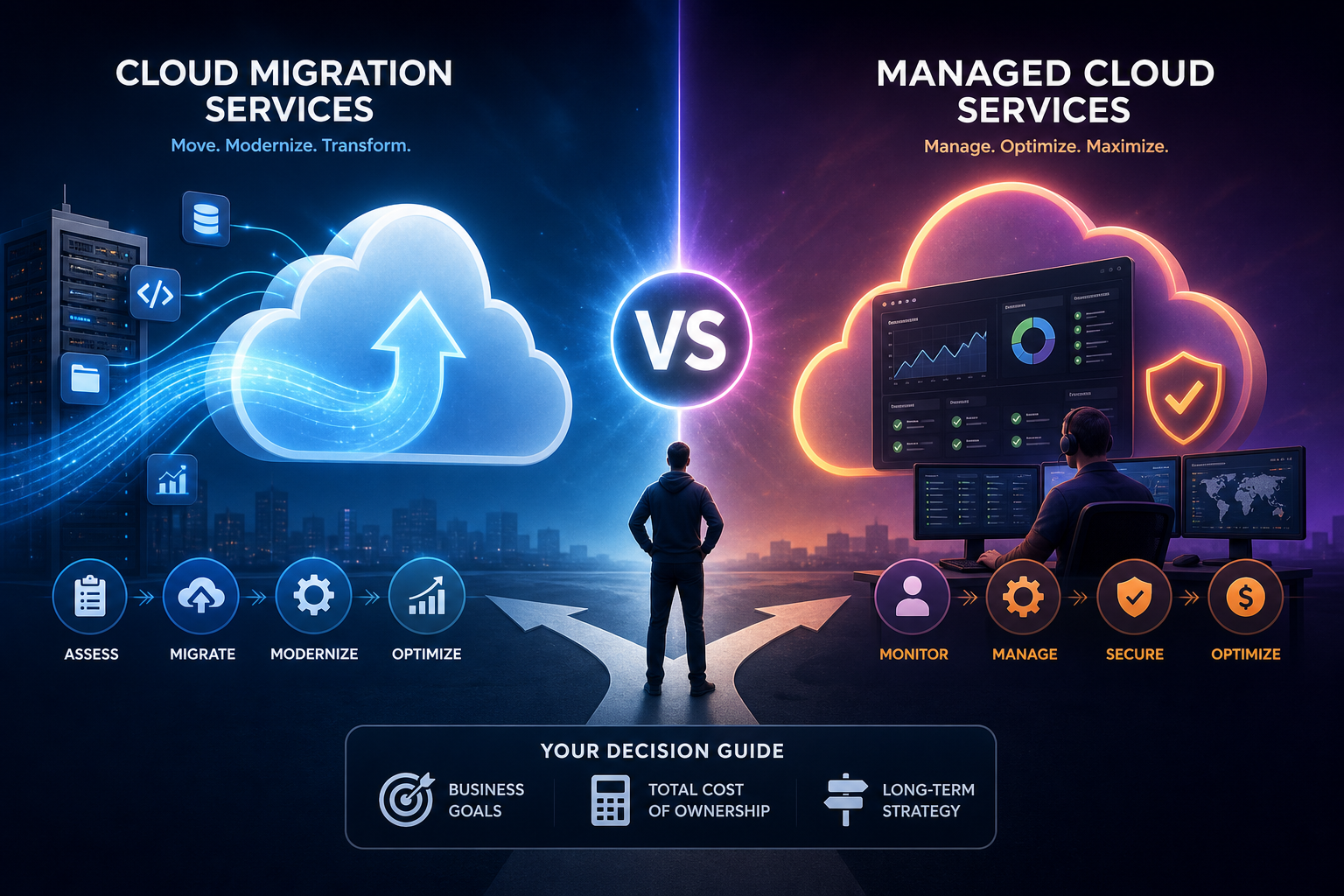
Imagine this: your IT team is deep into planning a move to the cloud. Legacy platforms are still running, compliance rules are changing, and your business can’t slow down just because technology needs an overhaul. Everybody wants the transition to go smoothly, but there’s confusion about who handles what—and IT is on the hook for making it all work. The decision between cloud migration services vs managed cloud services quickly turns into more than a technical question. It’s about limiting risk, keeping costs under control, and making sure support is ready when you need it so your business stays on track after go-live.
What happens at each stage of a cloud migration
A well-run cloud project always starts with a clear plan. Microsoft Azure’s six-stage migration framework is used by a lot of teams as a baseline: Define strategy, Plan, Ready, Migrate, Govern, and Manage. Each step has a specific goal as you move from on-premises to the cloud.
The first four steps—strategy, planning, readiness, and migration—are usually handled by migration services. During these phases, a provider works with you to lay out business drivers, analyze workloads, prepare the environment, and execute the move. Take the “Ready” phase, for instance: this is where your IT group and the migration partner run test workloads, tweak configurations, and make sure everything’s set before the real migration begins.
But once the migration is finished, the work doesn’t just stop. “Govern” and “Manage” are the final phases. These focus on cloud security, compliance, cost controls, and day-to-day operations. That’s where managed cloud services come in. Migration services get you to the cloud; managed services keep your environment running smoothly and securely long after launch.
This division isn’t just paperwork. It clarifies who’s responsible at each step and what you should expect from your partner. Without a clear transition, you could end up with blind spots—especially when it comes to governance or ongoing management—which can turn into surprise costs or security issues.
After your data and apps are in the cloud, someone has to keep them running well. That’s where managed cloud services take over, handling all the critical tasks that can easily get overlooked once the migration celebration winds down.
A managed cloud services provider usually bundles monitoring, security, backup, provisioning, performance management, access controls, and compliance help into one package. You get round-the-clock monitoring, with alerts if something drifts out of policy or if an outage threatens uptime. Security chores like patching, vulnerability scans, and incident response are handled before they turn into problems, which takes pressure off your team and helps with audits.
Performance tuning and cost control aren’t just one-time setups. Managed cloud services routinely check your usage, adjust resources, and suggest ways to avoid surprise bills. If your company uses hybrid or multi-cloud setups, these services are even more important—managing it all manually just isn’t realistic at a certain size.
It’s worth noting: some managed service providers offer migration help, but their main job is ongoing operations. As Tailwind Voice & Data puts it, “cloud migration is the process of moving workloads, applications, or data into a cloud environment,” while “managed cloud services focus on ongoing operation, optimization, security, monitoring, and support of that environment after the migration is complete.” Knowing this difference helps set realistic expectations for what happens after the migration work is done.
Managed migration vs in-house: how the workflows and risks compare
The real question for many organizations is whether to run the migration themselves or hire a provider for managed migration. What matters is who’s responsible for the outcome—and how much risk you want to absorb.
A managed migration is a project with a clear contract. The provider takes charge from start to finish. They’ll begin by discovering and assessing your current systems, mapping dependencies, and planning the migration. Then they design the target architecture, carry out migration waves, test everything, and stabilize workloads before passing the baton to the operations side for ongoing support.
Provider ownership isn’t limited to technical tasks. Things like uptime SLAs or performance benchmarks are built into the contract, so the provider is on the hook for meeting those goals. If you do everything in-house, your IT team takes all the planning, troubleshooting, and surprise problems on themselves. Even if you use tools like AWS Migration Hub or Azure Migrate, you have to coordinate the process and deal with any fallout if things don’t go as planned.
Choosing managed migration can lower your operational risk. Providers bring experience and proven methods, so you’re less likely to run into downtime, data loss, or cost overruns. If your team doesn’t have deep cloud expertise, having a partner handle the heavy lifting means fewer headaches and a smoother path to a stable, production-ready cloud environment.
Not every business needs the same level of ongoing help. Managed cloud services are especially useful when your internal team is already stretched thin or when uptime is truly critical.
Picture a company with just a handful of IT staff. They might be able to get you through the migration, but monitoring, security, and compliance work never really stops. Offloading those jobs to a managed provider lets your team focus on bigger projects and keeps them from burning out.
Companies that are growing fast or opening new offices often find managed services essential. Coordinating cloud resources across multiple locations can quickly overwhelm a small IT team. Managed providers bring order to the chaos, handling new branches and extra workloads as your business expands.
If your workloads power customer-facing apps or critical business processes, even a short outage might cause real trouble. Managed cloud services give you 24/7 monitoring and incident response, which is hard to match with a small in-house team—especially if you can’t justify staffing overnight shifts.
Hybrid and multi-cloud setups add another level of complexity. Keeping security, performance, and settings consistent across platforms takes specialized skills. Managed service providers have the tools and know-how to keep these environments running without issue, no matter how big they get.
Costs, optimization, and long-term value in managed cloud models

One major difference between migration-only and managed cloud service models is how the costs break down—and how predictable those costs are.
Cloud migration services are usually one-time projects. You pay for a set scope: strategy, planning, readiness, migration. That’s straightforward, but after you’re in the cloud, ongoing management lands on your plate. If you need extra help or hit a snag, costs can rise quickly.
Managed cloud services are designed for steady, predictable spending. Most providers charge a flat monthly fee that covers routine management, monitoring, security, and optimization. That makes budgeting easier and takes the surprise out of monthly cloud bills.
There’s extra value in ongoing optimization. Managed providers keep an eye on your environment, adjust resources, and make sure you’re not overpaying for unused services. Cloudian describes this as integrated hybrid IT management with the benefit of flat, predictable spending—a clear contrast to the sometimes unpredictable costs of migration-only projects.
For organizations running at scale or juggling multiple clouds, skipping ongoing optimization often costs more in the long run than outsourcing management. Managed cloud services help you turn your cloud operations into a steady, manageable line item.
How to choose the right approach for your cloud strategy
Picking between migration-only projects and managed cloud services isn’t just a technical decision; it’s about matching your cloud journey to your business’s real needs.
If your main challenge is just getting to the cloud and your team has the skills, a focused migration project might be all you need. If you want support after go-live, need predictable costs, or have a complex or distributed environment, managed cloud services offer a more complete solution.
Think about your IT team’s workload, your company’s risk tolerance, and whether you can meet uptime or compliance demands. Can your staff keep cloud workloads running, secure, and optimized every day, or is it smarter to leave those tasks to a partner with proven processes?
A hybrid approach often works best: start with a well-scoped migration, then shift to managed services for day-to-day operations. This way, you get a smooth move to the cloud and confidence that your investment will keep working for you long after the migration itself is done.

I’m Omar Khalil, and I’ve spent the past decade working within the MEA technology channel ecosystem, from distribution in Dubai to partner enablement across Africa. I write about practical strategies for vendors, distributors, and resellers navigating the unique challenges of selling technology solutions in the Middle East and Africa. My focus is on actionable intelligence drawn from real market experiences, not generic theory. When I’m not writing, I’m usually at a channel event somewhere between Riyadh and Read the full About the author page.