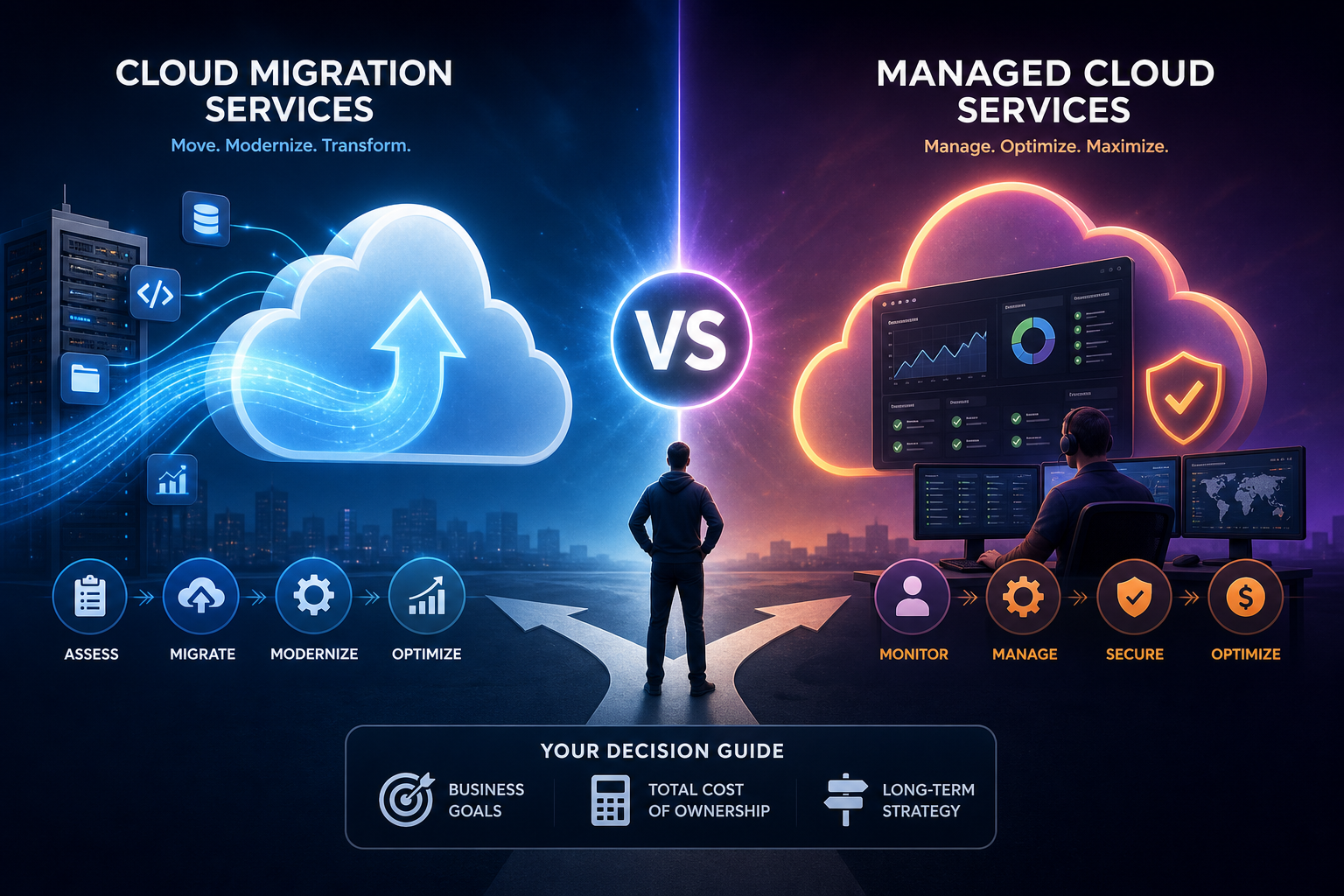
MSSP vs In-House SOC: The Real TCO Breakdown for 2026

A CFO reviewing a Security Operations Center proposal in 2026 sees two numbers side by side: a fully loaded in-house build that lands north of $2.6 million in year one for genuine 24/7/365 coverage, and a managed detection and response quote that looks like a third of that. The instinct is to sign the MSSP contract and move on. That instinct is often correct, but usually for the wrong reasons, because most of the TCO comparisons circulating in vendor decks right now are built on stale headcount assumptions, pre-AI alert volumes, and tooling prices from 2023. This breakdown rebuilds the comparison from the ground up, using 2026 salary bands across North America, Europe, and the GCC, current SIEM and XDR ingestion pricing, and the recruitment, ramp-up, and burnout economics that neither side of the sales conversation leads with.
The 2026 Economic Reality: Why the Old SOC Math No Longer Holds
Three forces have collided to break the spreadsheets that CISOs used to justify SOC budgets in 2022 and 2023. First, alert volume has grown faster than headcount. AI-assisted reconnaissance and commodity attack tooling now generate reconnaissance and probing traffic at a scale that pushes a mid-size enterprise’s raw alert count into the thousands per day, long before correlation rules trim it down to something a human can triage. Second, IT and security budgets have flattened or shrunk in real terms across most sectors heading into 2026, while cyber insurance underwriters and boards are demanding faster detection and response times as a condition of coverage. Third, the SOC labor market has not cooled. Tier 2 and Tier 3 analysts with cloud, identity, and threat-hunting skills remain scarce, and annual turnover in SOC roles is running at an industry average of roughly 28 percent, driven by shift fatigue, alert overload, and better offers from MSSPs and cloud providers who can pay more because they amortize headcount across many clients.
The result is a structural mismatch: the cost of running a credible in-house SOC has gone up, the talent needed to staff it has gotten harder to keep, and the tooling required to keep pace with modern attack volume has gotten more expensive per gigabyte ingested. Meanwhile, the MSSP and MDR market has matured enough that “managed security” in 2026 no longer means a call center reading Splunk dashboards. It means dedicated detection engineering, automated containment, and in many cases faster mean time to respond than an internally built team can achieve in its first eighteen months of operation. None of that means MSSP is automatically the right answer. It means the comparison has to be run honestly, with real numbers, not the three-analyst fantasy that still shows up in board decks.
The Anatomy of an In-House 24/7 SOC: The True Headcount Math
Why Three Analysts Cannot Run 24/7 Coverage
The most common budgeting mistake CISOs make is assuming three analysts, one per eight-hour shift, can deliver round-the-clock coverage. That model works on a whiteboard and fails within the first quarter. A calendar year contains 8,760 hours. A single full-time employee, after accounting for public holidays, 15 to 20 days of paid time off, average sick leave, and mandatory training and certification hours, delivers roughly 1,800 to 1,850 productive hours a year, not the 2,080 a naive 40-hour-week calculation suggests. Dividing 8,760 by that realistic productive-hours figure means it takes a minimum of 4.5 to 4.7 full-time employees just to keep one single seat staffed at all times, with zero redundancy for the inevitable overlap of illness, resignation notice periods, and unplanned absence. Three analysts covering three shifts leaves no coverage for weekends, no buffer for leave, and no capacity for the Tier 2 escalation and Tier 3 threat hunting work that has to happen in parallel with front-line monitoring.
The Real Coverage Model
A defensible 24/7/365 SOC with genuine tiered escalation requires the following minimum structure for a 1,000-user enterprise generating a moderate-to-high daily alert volume:
- Tier 1 Analysts (continuous monitoring and triage): 5 FTE. This covers a single always-staffed seat with the redundancy buffer described above, plus overlap for the highest-volume shift windows.
- Tier 2 Analysts (investigation, correlation, escalation handling): 3 FTE. Extended-hours coverage plus on-call rotation for nights and weekends.
- Tier 3 Analysts / Threat Hunters / Incident Response Leads: 2 FTE. Deep investigation, malware analysis, and hands-on containment during active incidents.
- SOC Manager / Team Lead: 1 FTE. Shift scheduling, quality assurance, escalation ownership, vendor and audit liaison.
That is a minimum of 11 full-time employees for a defensible tiered operation, not the 5 to 8 that budget planners often pencil in when they first scope the build. Organizations that try to run 24/7 coverage with 6 to 8 people almost always end up with gaps in weekend or overnight escalation coverage, analysts pulling mandatory overtime that accelerates burnout, and a Tier 1 queue that backs up faster than it clears during any concurrent incident. This is precisely the staffing shortfall that feeds the 28 percent annual attrition figure: understaffed rotations burn out the analysts who are covering the gaps, and the resulting turnover makes the staffing gap worse the following quarter.
Salary Reality: GCC and North America/Europe Compared
Compensation for this 11-person structure varies significantly by region, but the gap is smaller than raw salary tables suggest once loaded costs are factored in.
UAE and broader GCC market (2026 bands): Tier 1 analysts command AED 25,000 to 30,000 per month, Tier 2 analysts AED 30,000 to 38,000, and Tier 3 or lead analysts AED 38,000 to 45,000, with SOC managers typically clearing AED 45,000 to 50,000. Using a blended midpoint of AED 27,000, 34,000, 41,000, and 48,000 respectively across the four role bands, the raw annual base salary bill for the 11-person structure comes to approximately $1,199,000 at current exchange rates. Once employer-side costs are added, including UAE end-of-service gratuity accrual, mandatory health insurance, visa and labor card fees, and housing or transport allowances common in GCC compensation packages, the fully loaded figure rises to roughly $1,463,000 per year, a load factor of about 22 percent on top of base salary.
United States and Western Europe (2026 bands): Tier 1 analysts base at $95,000 to $110,000, Tier 2 at $115,000 to $135,000, and Tier 3 at $140,000 to $160,000, with SOC managers in the $160,000 to $175,000 range in most major metros. Using blended midpoints, the raw base salary bill for the same 11-person structure totals approximately $1,340,000. Loading for payroll tax, health benefits, 401(k) or pension matching, and PTO accrual at a typical 32 percent load factor brings the fully loaded annual figure to approximately $1,769,000 per year.
The takeaway CFOs consistently miss: GCC salary bands look dramatically cheaper on paper, but once benefits, EOSB, visa sponsorship, and the region’s typically higher relocation and housing allowances are loaded in, the gap versus a US or European team narrows to roughly 17 to 20 percent, not the 40 to 50 percent a naive base-salary comparison implies.
Modern Security Tech Stack TCO in 2026
Headcount is only half the bill. The technology stack required to give that headcount something useful to work with is a five- or six-figure recurring cost on its own, and ingestion-based SIEM pricing has become the single most volatile line item in a SOC budget.
- SIEM ingestion (Microsoft Sentinel): Consumption pricing runs roughly $1.50 to $2.80 per GB per day depending on commitment tier. A 1,000-user enterprise typically generates 150 to 220 GB of daily log volume once endpoint, identity, network, cloud, and application logs are all onboarded. At a blended $1.80 per GB per day, that is approximately $118,000 to $145,000 per year in ingestion costs alone, before archive and cold-tier retention charges for logs kept beyond the 90-day hot window required by most compliance frameworks.
- SIEM alternative (Splunk): Traditional ingest-based licensing at comparable volumes typically runs 15 to 30 percent higher than Sentinel at enterprise scale, commonly landing in the $150,000 to $210,000 per year range for a 1,000-user log profile, a major reason many mid-market enterprises have migrated toward consumption-based cloud-native platforms since 2024.
- Unified SIEM/XDR (Palo Alto Cortex XSIAM): Positioned as a premium consolidated platform combining SIEM, XDR, and SOAR, typically priced on a blended per-GB and per-endpoint basis. For a 1,000-endpoint enterprise, realistic annual spend lands between $150,000 and $260,000, depending on retention and automation tier, though it can reduce the need for a separate SOAR license.
- SOAR / automation platform (if not bundled): $60,000 to $90,000 per year for playbook licensing and integration connectors at enterprise scale.
- EDR/XDR agents (CrowdStrike Falcon): $9 to $19 per endpoint per month depending on module tier (EDR only versus Falcon Complete with managed response). At a blended $15 per endpoint per month across 1,000 endpoints, that is $180,000 per year.
- Threat intelligence feeds: Premium commercial feeds (Recorded Future, Mandiant, or equivalent) typically run $40,000 to $80,000 per year for one to two subscriptions.
- Cold/hot storage and data lake retention: Compliance-driven long-term retention (often 12 months hot, up to 7 years archived for regulated sectors) adds $30,000 to $45,000 per year beyond primary SIEM ingestion costs.
Using the Sentinel plus CrowdStrike plus SOAR configuration as the representative 2026 stack, a defensible tooling budget for a 1,000-user in-house SOC totals approximately $515,000 in year one, growing at roughly 8 percent annually as data volume, endpoint count, and retention requirements expand. This figure does not include the initial capital expenditure for facility hardening, redundant connectivity, network tap infrastructure, and deployment engineering, which typically adds $180,000 to $220,000 as a one-time year one cost.
Comprehensive 3-Year TCO Comparison
The table below models total cost of ownership over a three-year horizon for a 1,000-user enterprise, using the US/Europe blended salary scenario for the in-house model (the GCC scenario runs roughly 17 to 20 percent lower on the salary line only, with tooling and setup costs remaining broadly comparable due to regional data residency and hosting requirements). The MSSP/MDR column reflects a full-service contract with active containment authority, not a passive log-monitoring or notify-only engagement.
| Cost Category (3-Year Total) | In-House SOC (11 FTE, Tiered) | Dedicated MSSP/MDR |
|---|---|---|
| Initial Setup / Capex | $270,000 | $55,000 |
| Annual Engineering Salaries / Contract Labor | $5,523,000 | $1,686,000 |
| Tooling / Licensing | $1,671,000 | $189,000 |
| Continuous Training & Certification | $198,000 | $25,500 |
| Talent Turnover / Replacement | $372,000 | $30,000 |
| Total 3-Year Estimated Spend | $8,034,000 | $1,985,500 |
Read carefully, not as a verdict. The MSSP column’s “Annual Engineering Salaries / Contract Labor” row combines the MDR contract fee, which is how the provider’s analyst labor is monetized, with the cost of a single internal Security Program Manager retained to govern the relationship, validate SLA performance, and hold business context the MSSP cannot access on its own. The “Tooling / Licensing” row for MSSP reflects only supplemental tooling the enterprise still owns directly, such as identity and email security layers frequently kept in-house even under a full MDR arrangement, since most MDR contracts bundle EDR agent licensing and SIEM ingestion into the service fee itself. On headline numbers, the in-house build costs roughly four times the MDR alternative over three years. That gap is real, but it is not the whole story, and the next two sections explain exactly what that lower MSSP number does and does not buy.
The MSSP/MDR Alternative: What You Actually Buy vs What You Lose
Shared-Analyst Pools vs Dedicated Pods
The economics that make MSSP pricing so favorable come from one structural fact: a single MSSP analyst typically monitors six to twelve client environments concurrently, not one. That is how a provider can charge $30 to $45 per user per month and still turn a profit while paying competitive analyst salaries. It is also the source of the model’s biggest limitation. A shared-pool analyst has minutes, not hours, to spend understanding any single client’s environment before moving to the next queue item. Premium MDR contracts increasingly offer “dedicated pod” tiers, where a named team of analysts is assigned exclusively to one client account, but this tier typically costs 40 to 70 percent more than the shared-pool baseline, closing much of the cost gap modeled above. Enterprises evaluating MSSP contracts need to know explicitly which model they are buying, because the marketing language rarely distinguishes the two clearly.
The Context Deficit
An MSSP analyst does not know that your finance team runs a legitimate quarterly batch process that looks like data exfiltration to a generic detection rule, or that your DevOps pipeline routinely spins up short-lived cloud instances that a naive anomaly model flags as suspicious lateral movement. This context gap is the single most common source of both false positives that burn analyst time on the provider side, and false negatives, where a genuinely malicious action gets waved through because it superficially resembles known-normal business activity. Closing this gap requires investment on the client side: detailed asset inventory documentation, business logic runbooks, and a named internal point of contact who understands both the business and the threat landscape well enough to tune detection logic over time. Enterprises that sign an MSSP contract and walk away without this investment consistently report worse detection outcomes than the ones that treat onboarding as a six-to-eight-week joint engineering project.
SLA Traps and Notification-Only Contracts
Read the containment language in any MSSP or MDR contract before signing, not after the first incident. Many mid-tier MSSP agreements are notification-only: the provider detects and alerts, but a human on the client side has to authorize and execute containment actions such as isolating an endpoint or disabling a compromised account. In a ransomware scenario where dwell time between initial access and encryption can be under four hours, a notification-only model that requires the client’s own on-call staff to act can erase most of the speed advantage the MDR contract was sold on. Full MDR contracts with pre-authorized containment authority exist, but they typically carry a liability and scope negotiation that takes legal and security teams several weeks to work through, and they cost meaningfully more than the notification-only baseline. Confirm containment authority, mean time to respond guarantees with financial penalties attached (not just mean time to detect), and the exact list of pre-approved automated actions before treating any MSSP quote as comparable to another.
The Hybrid Co-Managed SOC: The Model That Wins for Most Enterprises
For roughly 70 percent of mid-market and enterprise organizations, neither the fully staffed in-house model nor the fully outsourced MSSP model is the right answer. The hybrid, or co-managed, SOC structure outsources Tier 1 triage, the highest-volume, most repetitive, and hardest-to-staff layer, to an MSSP, while retaining Tier 2 and Tier 3 incident response, threat hunting, and detection engineering in-house. This structure captures the majority of the cost advantage on the headcount line, since Tier 1 alone represents roughly 45 percent of the full 11-person build modeled above, while preserving the business context and containment authority that a pure outsourcing model sacrifices.
Under this model, the internal team shrinks from 11 FTE to approximately 5, comprising two Tier 2 analysts, one Tier 3 lead, one detection engineer who owns SIEM correlation logic and tunes the MSSP’s escalation criteria, and one SOC or security manager who owns the MSSP relationship and quarterly performance review. Annual loaded salary cost for that 5-person team lands around $820,000 to $900,000 in the US/Europe scenario, versus $1,769,000 for the full build. Combined with a Tier 1-only MSSP contract, typically priced at $12 to $18 per user per month rather than the $30 to $45 full-MDR rate, total annual spend for the hybrid model often lands 35 to 45 percent below the pure in-house build while retaining significantly more control and context than a fully outsourced arrangement. This is why hybrid has become the default recommendation across most enterprise security advisory engagements heading into 2026, not because it is the cheapest option on paper, but because it is the one that survives contact with an actual incident.
Decision Matrix: The Audit CFOs and CISOs Must Run Before Signing Anything
Before opening headcount requisitions or signing an MSSP contract, work through these questions jointly, with finance and security in the same room:
- What is our real regulatory data residency requirement? Organizations subject to SAMA’s Cyber Security Framework in Saudi Arabia, or entities governed by UAE data protection and critical infrastructure rules, frequently face constraints on where security telemetry and logs can be processed and stored, which can rule out certain MSSP hosting locations outright regardless of price.
- What is our actual daily alert volume, measured, not estimated? Pull 30 days of real SIEM or XDR alert data before sizing either a headcount plan or an MSSP contract tier. Estimates built on vendor sizing calculators are routinely 40 to 60 percent below actual volume once every log source is onboarded.
- Can we retain Tier 2/3 talent for at least 24 months? If the honest answer is no, given local market competition for cloud security and identity skills, the in-house model’s cost advantage evaporates the moment the 28 percent attrition rate hits and replacement and ramp-up costs compound.
- Does the MSSP contract include pre-authorized containment, or notification only? Price every quote against the same containment authority baseline, not against the headline monthly fee.
- What does our cyber insurance underwriter require for claims eligibility? Several major underwriters now specify minimum detection and response time thresholds, and in some cases specific control frameworks, as a condition of full claims payout after a breach.
- What is our compliance attestation timeline? A SOC 2 Type II audit cycle or a GDPR Article 32 technical measures review has different evidentiary requirements depending on whether monitoring is performed in-house or by a third party, and this affects both cost and audit preparation time.
- What is our true three-year growth trajectory in users, endpoints, and cloud workloads? Tooling costs scale with data volume, not headcount, so a growth-stage company’s ingestion bill can outpace its salary bill within 18 months.
Strategic Verdict for 2026
For organizations under roughly 2,500 employees without an existing security engineering bench, a full in-house 24/7/365 SOC build is very rarely the correct decision in 2026. The talent market cannot support it reliably, the tooling cost curve punishes smaller data volumes disproportionately, and the 28 percent attrition rate turns the operation into a permanent recruiting project rather than a security function. A Tier 1-outsourced, Tier 2/3-retained hybrid model, or a full MDR contract with verified containment authority for organizations with minimal internal security engineering capacity, is the more defensible choice.
For enterprises above roughly 5,000 employees, operating regulated infrastructure, or subject to strict data residency mandates under frameworks like NESA-aligned UAE critical infrastructure rules or SAMA in Saudi Arabia, a hybrid model with a strong internally owned Tier 2/3 function is usually the right target state, not because it is cheaper in isolation, but because it is the only structure that satisfies both cost discipline and the regulatory expectation of demonstrable internal security ownership. Pure in-house builds remain justified for a narrow band of organizations: those with data sovereignty requirements so strict that no third-party processing is permissible, or those with security operations mature enough to be a genuine competitive differentiator rather than a cost center. For nearly everyone else between those two extremes, the decision in 2026 is not MSSP versus in-house. It is how much of the stack to retain, and the honest financial modeling above should make that allocation decision, not a vendor’s sales deck.
Executive FAQ
What does a realistic hybrid MSSP pricing model look like compared to full MDR?
Tier 1-only outsourcing, where the MSSP handles alert triage and escalates confirmed incidents to an internal Tier 2/3 team, is typically priced at $12 to $18 per user per month. Full MDR with active containment authority across all tiers typically runs $30 to $45 per user per month. For a 1,000-user enterprise, that is roughly $144,000 to $216,000 per year for Tier 1-only versus $360,000 to $540,000 per year for full MDR, a difference that should be weighed against the internal Tier 2/3 headcount cost required to make the Tier 1-only model function safely.
How much does alert fatigue actually cost in measurable terms?
Independent SOC benchmarking consistently finds analysts spend 25 to 30 percent of shift time triaging alerts that resolve to false positives or low-value true positives. On a fully loaded Tier 1 analyst cost of roughly $115,000 per year including overhead, that translates to $29,000 to $35,000 of annual salary spend per analyst consumed by noise rather than genuine threat response, before accounting for the burnout and turnover this workload accelerates.
What contract termination and transition clauses should we negotiate into an MSSP agreement?
Require a minimum 90-day transition assistance period post-termination, full data and log export rights in a portable format, documented detection rule and playbook ownership (so custom tuning built during the engagement does not stay locked in the provider’s proprietary platform), and a termination-for-cause clause tied to measurable SLA breaches, not just termination-for-convenience with a long notice period that leaves a coverage gap.
How long does it realistically take to stand up an in-house SOC from a cold start?
Budget 9 to 14 months from headcount requisition to steady-state operation. This includes 4 to 6 months of recruiting and onboarding per role given current Tier 2/3 talent scarcity, 2 to 3 months of tooling deployment and integration, and a further 3 to 4 months of detection rule tuning before false-positive rates stabilize to a workable baseline. Organizations that budget 90 days for this timeline are budgeting for the marketing case, not the operational reality.
Does moving to an MSSP eliminate our compliance and audit burden?
No. Frameworks including GDPR, SOC 2, SAMA’s Cyber Security Framework, and UAE critical infrastructure requirements place accountability on the data controller or regulated entity, not the service provider. An MSSP contract can satisfy technical control requirements, but the enterprise remains responsible for vendor risk management, contractual right-to-audit clauses, and demonstrating governance oversight of the MSSP relationship itself during any regulatory examination.

I’m Omar Khalil, and I’ve spent the past decade working within the MEA technology channel ecosystem, from distribution in Dubai to partner enablement across Africa. I write about practical strategies for vendors, distributors, and resellers navigating the unique challenges of selling technology solutions in the Middle East and Africa. My focus is on actionable intelligence drawn from real market experiences, not generic theory. When I’m not writing, I’m usually at a channel event somewhere between Riyadh and Read the full About the author page.