How to evaluate shared responsibility in cloud security for MEA organizations

When a business in the Middle East or Africa moves its critical customer data to the cloud, the sense of risk shifts overnight. It only takes one assumption—like believing your cloud provider handles all encryption or reviews every access log—to end up facing regulatory headaches or real financial consequences. Plenty of IT leaders in the region have discovered, sometimes too late, that a breach or compliance violation happened because someone thought the provider was on top of it. That sinking moment of realizing “we missed something important” is common, and as cloud usage grows in everything from banking to healthcare, getting this division of duties right is more urgent than ever. Clear lines aren’t just technical details—they’re the difference between scaling confidently and sleepless nights.
Why shared responsibility matters for MEA organizations
Cloud adoption brings promise and complexity for businesses in the MEA region. Modernization is pushing more operations online, but local laws, sector rules, and business habits make security planning less straightforward. The shared responsibility model is supposed to make the split between provider and customer clearer. But in reality, plenty of teams still have trouble figuring out exactly who is in charge of which controls, especially when national regulations or sector-specific practices add extra layers. Without a clear, actionable breakdown of duties, organizations can find themselves exposed—often realizing it only when an audit lands or after an incident happens.
What shared responsibility looks like for IaaS, PaaS, and SaaS
To make sense of your own obligations versus the provider’s, start with your cloud service model. With Infrastructure as a Service (IaaS)—think AWS or Azure—the provider takes care of the physical data centers, servers, networking, and the virtualization layer. Your team is on the hook for the guest operating system, patching, configuring firewalls, managing user identities, and protecting all the data and applications you install.
With Platform as a Service (PaaS), the provider manages the infrastructure and much of the platform software, but you’re still responsible for securing your application code, managing access, and making sure data is encrypted when it needs to be.
Software as a Service (SaaS)—for example, cloud-based HR or CRM tools—means the provider does nearly everything under the surface. But your job isn’t finished. You need to decide who gets user accounts, set permissions, configure audit logs, and handle sensitive data in line with local compliance requirements.
For MEA businesses, this isn’t an abstract distinction. A healthcare provider in Kenya, for example, might use IaaS for a custom patient application, which puts configuration and security squarely on them, while using SaaS for payroll—where the big job is managing user access and checking the provider’s compliance with privacy laws.
What goes wrong when responsibilities aren’t clear
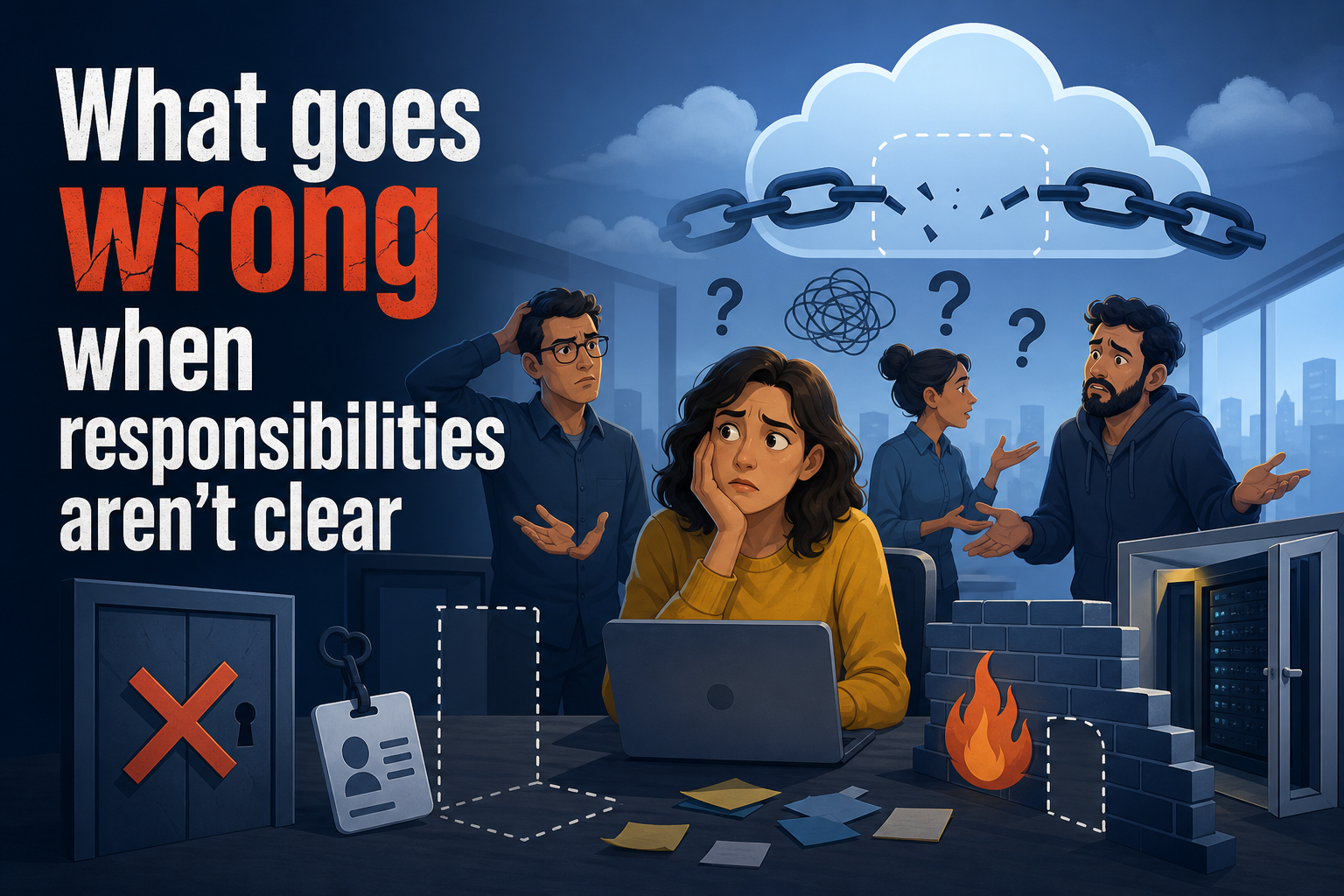
Misunderstandings about shared responsibility are a regular problem, especially in fast-moving cloud projects. Teams sometimes assume the provider covers everything, only to discover later that things like identity management or firewall setup were left untouched.
This blind spot often shows up with access controls. If nobody in the organization actively manages permissions, unused accounts or overly broad access can stick around for months, making life easier for attackers. Another common miss is skipping guest OS patches on virtual servers, thinking the provider handles it, when actually their job stops at the hardware and hypervisor.
For regulated MEA industries, these gaps can quickly result in compliance failures or audit findings. Regulators won’t accept “we thought the provider did it” as an excuse, especially when contracts or published documentation make the customer’s role clear.
The solution is to create a straightforward, repeatable process for mapping and tracking who owns which security tasks. Here’s how I do it in the field:
Major providers like AWS and Azure publish detailed breakdowns. List out which tasks are on the provider and which are on you.
3. Map every responsibility—from OS patching to firewall setup, identity management, encryption, and monitoring—to the right internal team or person. I use a RACI matrix (Responsible, Accountable, Consulted, Informed) to make ownership crystal clear.
4.
Check skills and tools. Make sure your team has the expertise and resources for every task that lands on your side. If there’s a gap—say, nobody knows how to set up advanced IAM policies—address it with training or new hires.
5. Update your map regularly.
As you add new cloud services or regulations change, review and update your responsibility chart and adjust contracts or procedures.
This method turns the shared responsibility model into something concrete you can use day-to-day. It also gives a direct answer when your boss or an auditor asks, “Who’s handling this control?”
Using certifications and contracts to make boundaries clear
Cloud providers often tout their certifications—ISO 27001, ISO 27017, ISO 27018, SSAE 18, SOC 2, and others—to prove their infrastructure and core services are secure. These are useful, but they don’t let your organization off the hook. You still have to secure your data, users, and configurations above what the certification covers.
Contracts and Service Level Agreements (SLAs) are equally important. Get the full contract and all associated SLAs for your cloud services. Highlight every section related to “security of the cloud” (the provider’s turf) and “security in the cloud” (your responsibility). Look closely at parts about incident detection, logging, and reporting—these are common gray areas.
If you find anything unclear or undefined, don’t ignore it. Write down these points, ask the provider for clarification, and if needed, request contract language that makes accountability explicit. This is especially important in MEA, where local laws can differ from global templates. If you’re unsure, compare your approach to recognized authorities like the UK National Cyber Security Centre (NCSC) or the US Department of Defense CIO, both of which recommend spelling out responsibilities in contracts.
Real-world examples of joint responsibility in the cloud
Some cloud security tasks require true teamwork between you and your provider. Auditing and monitoring are classic examples: the provider supplies logs and monitoring tools, but your team must set up collection, define alerts, and actually review events for anything suspicious.
Let’s take an AWS workload as an example. AWS handles physical security, servers, storage, and virtualization. Your team must patch the guest OS, configure firewall rules (security groups), manage IAM roles, and make sure data encryption is enforced for data at rest and in transit.
With SaaS, the provider takes care of the underlying application and infrastructure, but your organization still manages users, access rights, and audit logs. In these environments, your team is responsible for ensuring that only authorized users can access sensitive data and for monitoring usage to support compliance requirements.
Provider tools like AWS IAM or Azure Active Directory are essential for your side of the deal. Regularly check user roles, apply least-privilege access, and make sure strong authentication is in place. Don’t assume the provider configures these settings based on your internal policies—you need to verify and adjust them.
Making shared responsibility work in real life
Shared responsibility isn’t something you set once and forget. After mapping and assigning tasks, set a schedule to review everything regularly. As you add cloud services or as new regulations appear, update your responsibility map and adapt team processes and contracts.
For MEA organizations, prioritizing identity management, data protection, and API security is particularly important. These are common targets for attacks and usually fall on the customer side. If you’re uncertain, take ownership until you confirm otherwise through documentation or contracts.
Finally, make sure everyone—IT, compliance, business managers, and operations—understands how duties are divided. The aim isn’t just to pass an audit, but to give customers and partners real confidence in your cloud security. When each person knows their part, you stop cloud security from being a source of confusion and turn it into a foundation for safer growth.

I’m Omar Khalil, and I’ve spent the past decade working within the MEA technology channel ecosystem, from distribution in Dubai to partner enablement across Africa. I write about practical strategies for vendors, distributors, and resellers navigating the unique challenges of selling technology solutions in the Middle East and Africa. My focus is on actionable intelligence drawn from real market experiences, not generic theory. When I’m not writing, I’m usually at a channel event somewhere between Riyadh and Read the full About the author page.