7 mistakes to avoid when pricing managed services

You can feel when your managed services pricing isn’t quite right. Maybe it’s the nagging worry after a client renewal, or the moment you notice your margin slipping as vendor costs creep up. Many MSP leaders have sat across from long-term clients still paying $85 per user—rates locked in years ago—wondering why the numbers don’t add up. You’re not alone if you’ve ever looked at your books and realized that old pricing decisions are quietly draining revenue you should be earning in 2026. The real cost of these mistakes isn’t always obvious at first, but the impact compounds with every renewal, every underpriced project, and every “free” service delivered.
Why pure cost-based pricing leaves money on the table
Relying only on a cost-plus approach feels safe—cover your expenses, add a margin, and send the quote. But in managed services, this method almost always leaves significant revenue behind. Recent industry data shows that skipping value pricing can cause MSPs to miss out on 20% to 40% of potential revenue at each renewal. That’s not just a theoretical gap; it’s money that could fund new hires, better tools, or even your next growth push.
The issue is that internal costs rarely reflect what clients are truly willing to pay for a managed outcome. Value-based pricing asks a different question: what is this solution worth to the client, given the risk it removes and the results it delivers? When MSPs move beyond the old habit of simply stacking up costs, they discover that many clients will accept—and even expect—higher fees for services that directly impact their business goals.
Getting started with value pricing doesn’t mean throwing out your cost analysis. Instead, it means layering in market benchmarks, competitive research, and honest conversations about client priorities. The payoff is real: with each contract cycle, aligning price with value helps you capture more of the upside you’re already creating.
The hidden cost of never increasing your managed services rates
It’s easy to postpone pricing reviews, especially when long-term clients seem content. But letting rates sit unchanged for years is a slow drain on profitability. Research-backed guidance for 2026 points to a straightforward benchmark: adjust your managed services pricing at least annually. For inflation alone, a 3%-5% increase per year is not just justified—it’s necessary to keep pace with rising costs.
If you’ve added new tools, enhanced services, or improved outcomes, the data supports an even higher annual adjustment: 8%-12%. This isn’t about squeezing clients for more revenue; it’s about keeping your own business healthy as software, labor, and vendor prices climb. The danger of skipping these regular increases is subtle at first, but over three or four years, cumulative underpricing can erode margins to the point where you’re subsidizing client growth out of your own pocket.
A practical routine is to review your pricing at least annually and plan accordingly. Communicate clearly with clients, tie rate increases to tangible improvements when possible, and avoid big, unexpected jumps by keeping small adjustments consistent each year.
Outdated client rates: the legacy-pricing trap
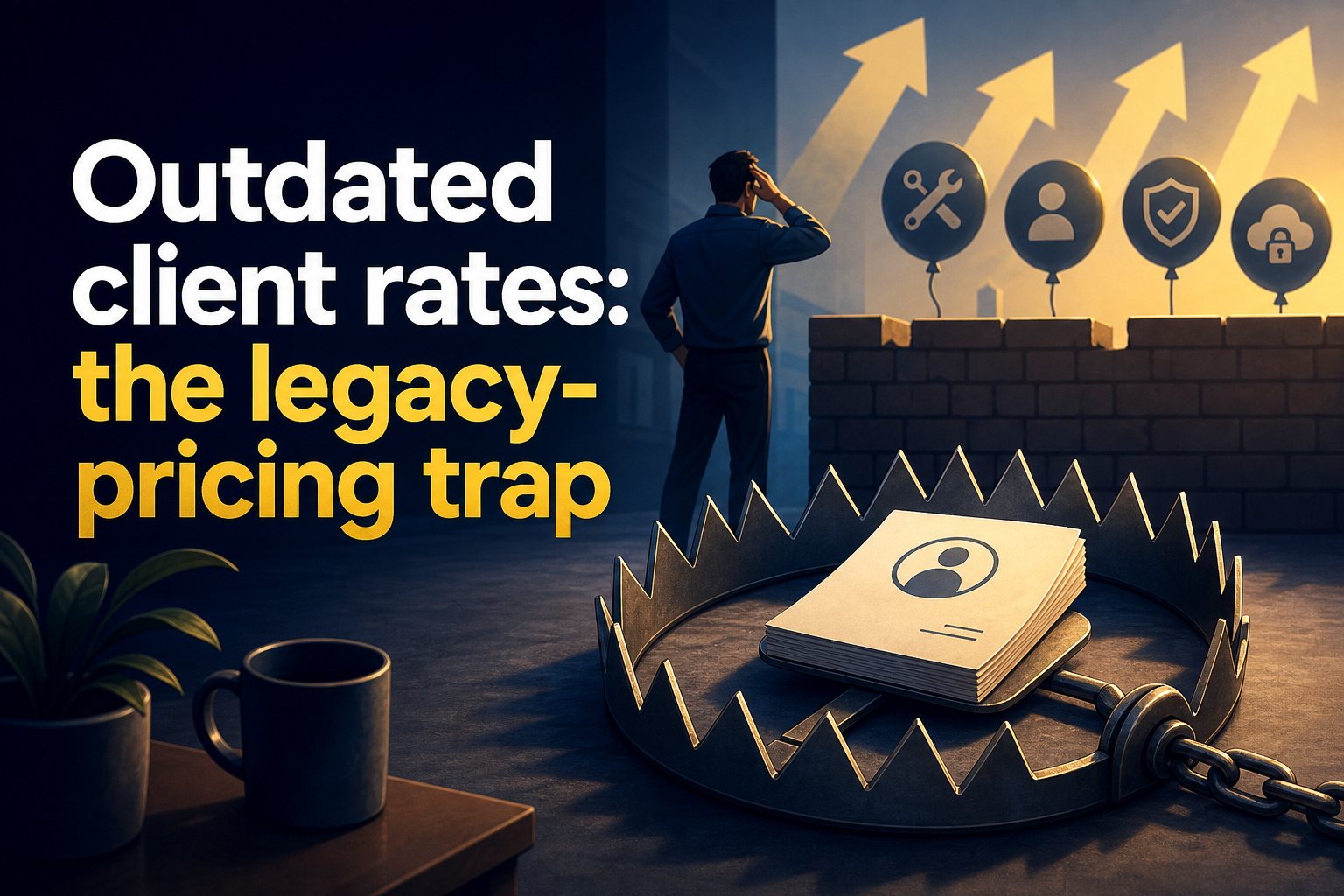
Nothing drags down MSP profitability faster than old contracts stuck at legacy rates. Take the all-too-common scenario: a client who signed on at $85 per user back in 2018 and is still paying that rate in 2026. In those eight years, your cost base has shifted dramatically—tools, labor, and compliance requirements have all pushed expenses up. Yet without a deliberate strategy to reset these legacy accounts, you’re essentially providing a discount every single month.
Resetting old rates isn’t just a numbers game. Many MSPs hesitate, afraid of rocking the boat with loyal clients. But the reality is that most business owners understand the world has changed since their last agreement. The key is to present a clear rationale: show how your services have evolved, outline the increased complexity or tools involved, and reference current market rates when proposing an update.
If you’re worried about pushback, consider offering a phased adjustment—step the rate up over two or three renewal cycles, but avoid letting legacy deals drift for another year. Every month you delay is lost revenue you’ll never recover.
Blurred lines: when project work eats into your margins
Project work and managed contracts are not interchangeable. Yet MSPs regularly fall into the trap of letting special projects—like a major network migration or a Microsoft 365 rollout—get bundled into the flat monthly fee. This “scope creep” quietly guts your margins, especially when project hours end up far exceeding what you budgeted for routine support.
The fix starts with a clear definition: project work means anything outside the agreed scope, timeline, or expected outcomes of your managed contract. If it doesn’t fit the standard support playbook, it’s a project—and it deserves its own quote and invoice. This distinction might sound obvious, but it’s amazing how often projects are absorbed as a “favor” or tossed in to sweeten a renewal.
By formally quoting project work, you not only protect your margins but also reinforce the value of your managed offering. Clients start to see that the monthly fee covers a well-defined set of outcomes, while extra initiatives are investments in their growth. Over time, this clarity can reduce awkward conversations and build more trust.
Ignoring inflation: the silent killer of MSP profitability
Vendor and tool costs rarely stand still. Every MSP knows the pain of a sudden price hike from a core software provider or security vendor. If you don’t have a strategy for passing through these increases, your profit margin shrinks with each new bill. The reality is that most clients expect some adjustment for inflation, especially in the tech sector where everyone is aware that tools improve and costs rise.
The most effective approach for 2026 is to include an annual contract clause that ties price adjustments to both the Consumer Price Index (CPI) and any tool-stack cost increases. This “CPI-plus-tool-cost” clause creates transparency: clients know upfront that their rate will rise in line with real, documented expenses, rather than arbitrary hikes. This also takes the pressure off uncomfortable negotiations; when the adjustment is written into the contract, it becomes a routine part of doing business.
Skipping this step is risky. Absorbing every vendor increase out of your own margin is unsustainable, especially as software costs accelerate year after year. A proactive, contractual adjustment keeps your pricing realistic and your business resilient.
Giving away value: why consulting and onboarding deserve a price tag
It’s tempting to include onboarding, consulting, or high-touch support as “free” add-ons to close a deal or simplify your offer. But over time, this erodes both your profitability and the perceived value of your expertise. Clients start to take these services for granted, and your team spends hours solving problems or architecting solutions with no compensation.
The fix is straightforward: spell out the value of onboarding, consulting, and support as explicit line items in your proposals and invoices. This isn’t about nickel-and-diming—it’s about being honest with clients about what it takes to get them set up and keep them running smoothly. When you separate these services, you can offer bundled discounts if needed, but you also create space to charge appropriately when the workload spikes.
Many MSPs discover that clients are willing to pay for these services when they see the direct impact—faster deployments, better training, or strategic planning that helps them avoid costly downtime. Explicit pricing for consulting and onboarding also makes it easier to scale your business, since you can allocate resources based on real revenue rather than hidden freebies.
One-size-fits-all pricing: why it doesn’t work for MSPs

Flat-rate pricing across your entire client base sounds simple, but it rarely matches the reality of your cost structure or client diversity. Small businesses with ten users generate a different workload—and risk profile—than a 200-seat enterprise. Yet many MSPs still charge the same per-user rate for everyone, missing out on the opportunity to set minimums for smaller clients or create tiered pricing for larger accounts.
The problem with one-size-fits-all is twofold. For small clients, you may end up delivering more support than their fee justifies, especially if they need extra hand-holding. For large clients, you might underprice the added complexity and risk, leaving revenue on the table that would be justified by their needs.
Instead, consider minimum monthly fees or tiered per-seat pricing for smaller clients or pricing tiers that reflect usage, complexity, or risk, as recommended by current industry guidance. This creates a win-win: small clients don’t get lost in the shuffle, and larger organizations contribute fairly to the resources they consume. Periodic reviews help ensure that tiers stay aligned with actual workload and client evolution.
How to fix your pricing strategy for 2026
If you’ve recognized one or more of these mistakes pricing managed services, the good news is that every one of them can be fixed—often with changes you can roll out before your next renewal cycle. Begin with an annual pricing review, cross-functional by design, so sales, finance, and service delivery all contribute their perspective. Shift your focus from just covering costs to capturing the value you create for clients, using market research and competitive benchmarks as your guide.
Add explicit contract clauses for annual CPI-plus-tool-cost adjustments, so inflation and vendor hikes don’t catch you off guard. Define project work clearly, and quote it separately from managed contracts. Price consulting, onboarding, and support as their own line items, and move away from flat rates by introducing minimums or tiers that reflect each client’s reality.
Here’s a quick checklist to get started:
Small, regular improvements in your pricing strategy can unlock revenue you’re already earning but haven’t claimed. In 2026, with costs and client expectations rising, these changes aren’t just best practice—they’re essential for every MSP that wants to thrive.

I’m Omar Khalil, and I’ve spent the past decade working within the MEA technology channel ecosystem, from distribution in Dubai to partner enablement across Africa. I write about practical strategies for vendors, distributors, and resellers navigating the unique challenges of selling technology solutions in the Middle East and Africa. My focus is on actionable intelligence drawn from real market experiences, not generic theory. When I’m not writing, I’m usually at a channel event somewhere between Riyadh and Read the full About the author page.